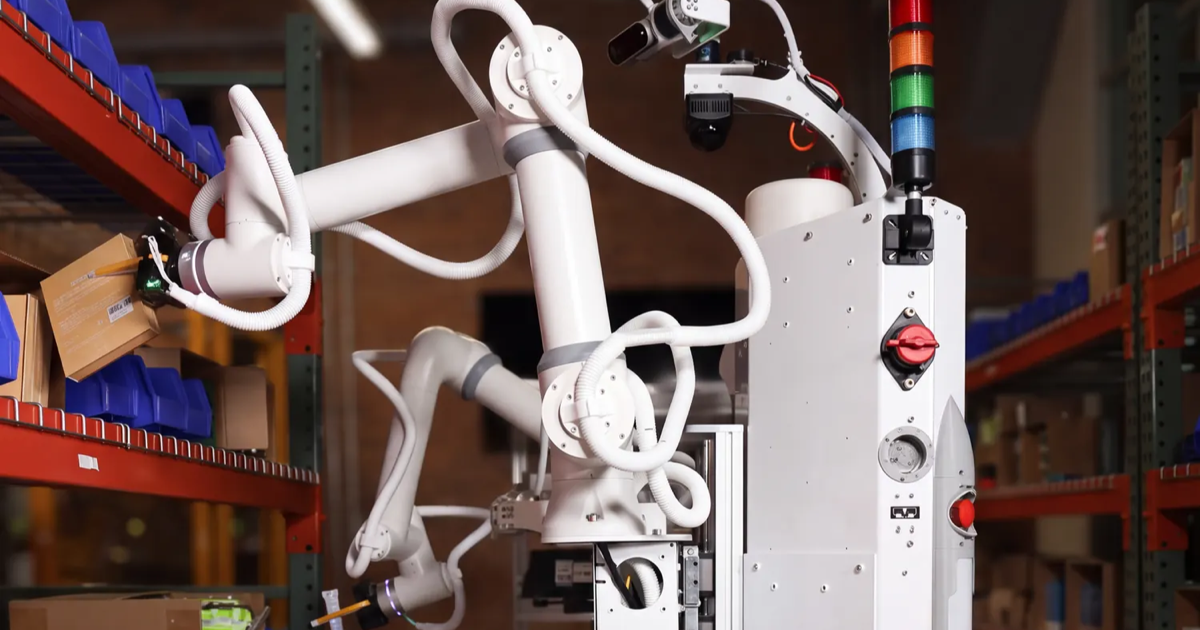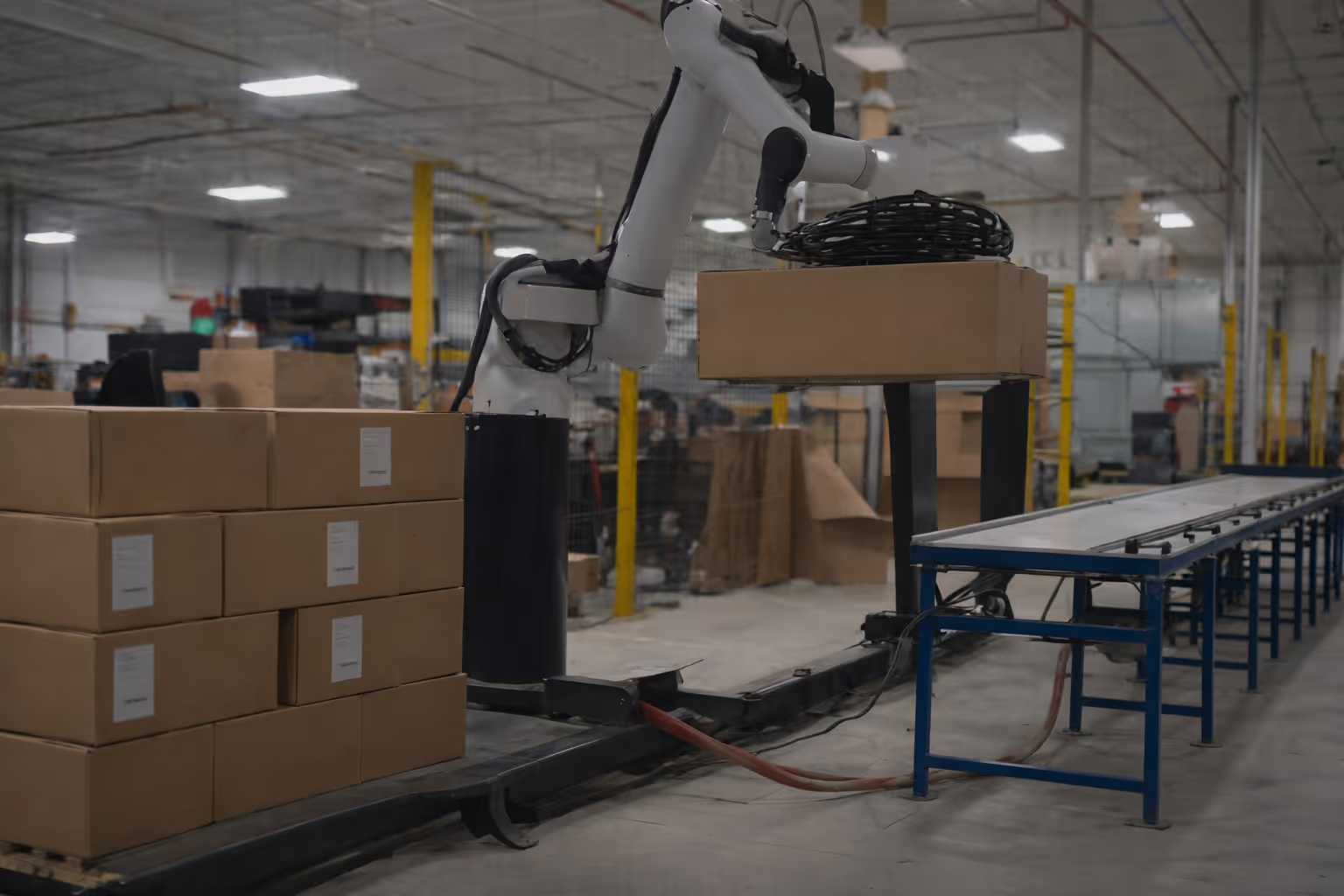
This past Fall I was approached by Josh Gruenstein, CEO of Tutor Intelligence, to see if I might be interested in playing an advisory role with the Tutor team. I was not interested at that time in taking on any additional commitments, but was intrigued with their story and the opportunity to learn more about the application of AI with cost effective palletizing robotics.
Many larger operations have already invested heavily into automated palletizing systems with good justification and success. But those of us who have had long careers in manufacturing and warehousing operations know how common it is to have some plants or portions of operations where it simply is not justified to commit capital to automated palletizing.
The team at Tutor has done a great job of creating a very attractive product in terms of ease of implementation, eliminating the hurdle of capital investment justification, and reducing operating costs. When I learned about their model of no capital investment required, no long-term commitment, no complex and time-consuming programming required (due to the AI capabilities of the robots), and the hourly cost advantage vs staffing with people, it was obvious that Tutor had an approach and offering that would be very attractive to companies not in a position to justify capital but looking for cost saving opportunities.
But I also saw that the Tutor solution offered more than just direct cost savings, and as I dug deeper before joining Tutor’s Customer Advisory Board, it became clear there were important additional benefits to highlight.
For those cases where automation of palletizing is not justified, the situation is similar everywhere: people tied to a “job” endlessly moving boxes from a conveyor belt to a pallet. In most cases, these roles are filled through temporary staffing agencies, and I think it is fair to say that most people that are placed in these jobs probably don’t find the experience very fulfilling. Manually palletizing for hours day after day is difficult. It’s repetitive, physically demanding, and it usually results in low satisfaction leading to high absenteeism levels. Over time, there is a cycle of needing to replace people either because they have self-selected out, or worse yet, the ergonomic stress leads to repetitive motion injuries.
Yet as companies begin to evaluate automation, sometimes the conversation is narrowed to a simple comparison of labor costs. If the robot costs X and the person costs Y, does it pay back?
In reality, the returns come not only from reduced wage costs, but also from improved safety, lower staffing costs (recruiting/training/turnover/overtime), and improved reliability by never having a gap in staffing.
1. Safety: Taking Ergonomic Risk Off the Table
Lifting 30–40 lb cases and stacking them for an entire shift is one of the most reliable sources of repetitive-motion injuries in a plant.
Most operations try to mitigate the rate of overuse injuries by frequently rotating employees. However, this simply results in a wider breadth of people facing strain injuries. You still end up with injured workers, restrictions, lost time, and the workers’ comp and disability costs that follow.
Automation changes the equation. Instead of fighting the constant battle to mitigate risk, we all know that automation can eliminate the risk entirely. Plant leaders work tirelessly to create an injury-free environment, and I believe most of those leaders who are so committed to improving safety are most frustrated with repetitive motion injuries because they are so hard to manage, especially when the capital investment to automate can’t be justified. In this case, automation is easily justified, eliminating ergonomic injuries, as well as the associated costs.
2. Staffing: A Job No One Wants to Do
The unfortunate truth is that the palletizing role is rarely a job people want to stay in long term. It’s physically exhausting and less engaging than higher-skill operator or maintenance work. As a result, it’s a job associated with chronic absenteeism and constant turnover. Supervisors end up scrambling at shift change, paying overtime to fill gaps, and repeatedly hiring and training new people only to start the cycle again.
A robot doesn’t call in sick, doesn’t leave for fifty cents more down the road, and doesn’t burn out. When you automate this role, you stabilize staffing overnight. The rest of the team can refocus their energy into more complicated tasks, enabling the entire line to become more consistent.
In tight labor markets, where there is intense competition and a lack of consistent labor, the stability that end-of-line robotic palletizing can provide can be the difference between hitting output targets and fighting fires all day. It also enables a labor strategy focused on hiring people for more fulfilling and meaningful careers in manufacturing and logistics.
3. Reliability: You must be confident in the solution
An obvious question that I asked as I was learning about the Tutor robotics solution was “What is the reliability performance of the robots? If something happens, what percentage of issues can be resolved quickly remotely (it turns out most)? If service is required, how quickly will you respond?
The answers I received were reassuring. Data on uptime shows the robots to be highly reliable, and if there is an issue, the systems are monitored real-time and most problems can be resolved remotely and very quickly.
The goal is simple: you should feel as or more confident in your ability to keep the line running with automation than you did with manual labor. If that isn’t true, you shouldn’t buy.
A Lower-Risk Way to Adopt Automation
Commercial models have also changed. Companies no longer have to commit capital or long timelines up front. Robotics-as-a-Service allows manufacturers to treat automation like operating expense: try it, run it, and keep it only if it delivers. That structure removes much of the hesitation smaller and mid-sized plants often feel when considering automation solutions.
The Bottom Line
End-of-line palletizing is the clearest example of a job that should be automated in modern manufacturing. It’s physically punishing, difficult to staff, and a source of consistent operational variability.
When you account for safer work, more stable staffing, and reliable performance — not just the benefit of wage savings — the ROI of robotic palletizing becomes far more compelling. Automation in this area isn’t a just a cut-and-dry cost decision; it’s a decision that impacts the stability and resilience of entire operation.